⇐ Return to Fertilizer & Amendment Technology & Use
¶ Manure salt content
Manure is typically applied at rates to meet crop nutrient requirements, so rates are generally limited by nitrogen or phosphorus content. The applied manure contributes to the soil salinity, so rates should also be managed to prevent excessive soluble salt accumulation from developing. Excess soluble salts can delay emergence, restrict growth, or result in crop injury.
“Salt” is a generic term referring to the readily water-soluble components of the manure (like chloride or ammonium) plus the less soluble mineral or organic substances that will eventually mineralize in the months following application. These may all contribute to soil salinity, which may affect crop growth or soil structure.
¶ Expressing salt concentration
The salt concentration, calculated as a percentage, is a quick way to compare the relative salinity impact of a manure. The percentage value can be used to calculate salt content as “pounds per ton (lb/ton)” or “pounds per gallon (lb/gal)”. The salt percentage can be calculated, as follows, using either the electrical conductivity (EC) value or results of a acid digestion (i.e., cation sum):
- a. Percent of manure, % = EC, as mmho/cm ÷ 15
- b. Parts per million, ppm = EC, as mmho/cm x 640; divide result by 10,000 to calculate percentage
- c. Percent of manure (by cation sum), % = (K% + Ca% + Mg% + Na%) x 2
Electrical conductivity is a direct measurement typically used to express the relative salt content of a water solution. It is commonly used to identify the salinity potential of wastewaters and liquid manures. The EC of a solid manure is determined from a water extract of the sample. EC is a quantitative measurement useful for comparison, but it does not express a mass or weight, so must be converted to a concentration equivalent. The results of calculations “a” and “b” are very close.
Manure nutrient content is routinely determined from an acid digest, with each nutrient expressed as a concentration (e.g., parts per million or percentage). The sum of the cation percentages, using calculation “c”, is considered to provide “a reasonable estimate of the amount of salt”.
The EC and cation sum methods are not directly comparable, because they consider different things. The EC measurement only includes the readily water-soluble components of the manure, those that enter the soil water and contribute directly to soil salinity. The concentration of the total digest for nutrient determination, including the cations, is a mix of the readily water-soluble substances, of the less soluble mineral or organic substances, and a portion of insoluble substances.
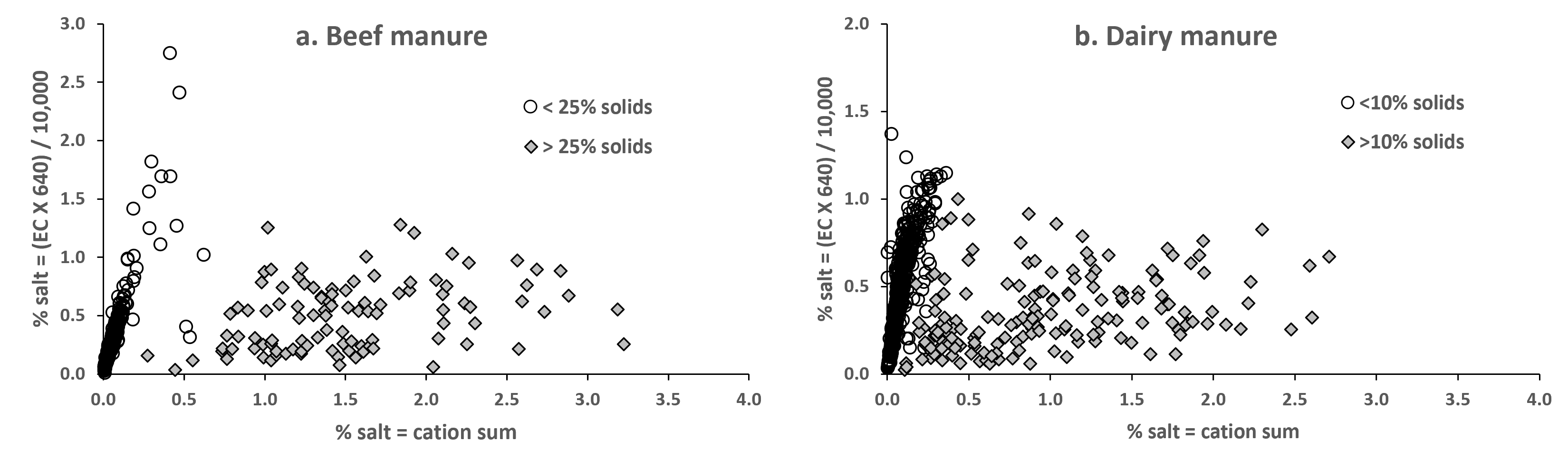
The three calculation methods are compared at the end of this Crop File. Calculating salt percentages using the two methods (EC or cation sum) will yield different results for the same sample, as illustrated in Figure 1. The relationship between the two methods can be affected by the moisture content. In this case, the methods diverge for the beef manure at about 25% solids and for the dairy manure at about 10% solids.
EC-based salinity guidelines for wastewaters or effluents (typically less than 5% solids) are found in the Water Resource Management section of the Crop File. These guidelines and corresponding limits assume equilibration between the water and soil during long-term irrigation. They do not require calculation of a weight or mass of applied “salt”.
The relative salinity potential of denser liquid, slurry, or solid manures can be estimated by using a “salt concentration” calculation. The following two sections show how the cation sum calculation method is used to estimate the hazard potential of applied manure. The soil texture, solids percentage, precipitation plus irrigation, and calculated salt content are used to identify a maximum annual application rate for a target soil salinity level.
¶ Estimating salinity hazard – solid manure
The percent salt calculated from cation summation (i.e., equation “c” above) is be used to estimate a maximum annual manure application rate to maintain soil salinity at either a medium or low level:
- Maintain "medium" salinity for corn, soybeans, and many field crops.
- Maintain “low” salinity for vegetables and more salt sensitive crops.
MaxSolid = ((TEXT ÷ (%DM ÷ 100)) x PCP) ÷ SALT
where:
- MaxSolid = suggested maximum annual manure application rate as “tons per acre (tons/ac)”
- TEXT = soil texture adjustment factor for low or medium salinity threshold
- %DM = percent dry matter or percent solids
- PCP = average annual precipitation plus annual irrigation applied, inches/year
- SALT = pounds of salt per ton of manure = [(% salt ÷ 100) x 2000]
| Solid manure adjustment factors | ||
| Texture class | Low salinity | Medium salinity |
| Fine (clayey soils) | 21 | 42.5 |
| Medium (loamy soils) | 24 | 55 |
| Coarse (sandy soils) | 32.5 | 68 |
Beef manure example: medium-textured soil and medium salinity (55 factor), 74% solids, 20 inches rainfall plus 15 inches irrigation (35 inches), 7.56% salt (or 151 lb salt/ton),
MaxSolid = ((55 ÷ (74% ÷ 100)) x 35 inches) ÷ 151 lb/ton
= ((55 ÷ 0.74) x 35 inches) ÷ 151
= (74.3 x 35 inches) ÷ 151
= 2601 ÷ 151
= 17.2 tons/acre, suggested maximum annual application rate to maintain medium salinity
¶ Estimating salinity hazard – liquid manure
A similar equation is used to estimate the maximum application rate for liquid or slurry manures.
MaxLiquid = [(((TEXT ÷ (%DM ÷ 100)) x PCP) ÷ (SALT x 4.25)] x 1000
where:
- MaxLiquid = suggested maximum annual manure application rate, “gallons per acre (gal/ac)”
- TEXT = soil texture adjustment factor for low or medium salinity threshold:
- %DM = percent dry matter or percent solids
- PCP = average annual precipitation plus annual irrigation applied, inches/year
- SALT = pounds of salt per ton of manure = (% salt ÷ 100) x 2,000
- 4.25 = density factor; 1000 gal. of manure ≈ 8500 lb. or 4.25 tons
| Liquid manure adjustment factors | ||
| Texture class | Low salinity | Medium salinity |
| Fine (clayey soils) | 95 | 191 |
| Medium (loamy soils) | 108 | 248 |
| Coarse (sandy soils) | 147 | 306 |
Hog slurry example: fine-textured soil and low salinity (95 factor), 39% solids, 20 inches rainfall with no irrigation, 7.18% salt (or 144 lb salt/ton)
MaxLiquid = [(((95 ÷ (39% ÷ 100)) x 20 inches) ÷ (144 lb/ton x 4.25)] x 1000
= [((95 ÷ 0.39) x 20) ÷ (144 x 4.25)] x 1000
= [(243.5 x 20) ÷ (612)] x 1000
= [4780 ÷ 612] x 1000
= 7.95 x 1000
= 7,960 gallons per acre, suggested maximum annual rate to maintain medium salinity
¶ Estimating sodium hazard
The sodium and potassium in applied manure can cause dispersion of soil aggregates. This can result in crusting and sealing, followed by increased surface runoff, reduced infiltration, and lower permeability. The permeability hazard for irrigation application is often estimated by the SAR (Sodium Adsorption Ratio). The CROSS calculation (Cation Ratio of Structural Stability) seems better suited for wastewaters or effluent because potassium content is typically much higher than fresh waters. Sodium is the main driver for dispersion, but potassium can contribute, though to a lesser degree. The SAR includes sodium, calcium and magnesium. The CROSS calculation also includes the potential impact of potassium.
The SAR or CROSS calculations are not useful for liquid or solid manures. The ratio of the sodium and potassium percentages to the total salt percentage can be used to identify the potential permeability hazard of these manures. The table below lists threshold values for the hazard ratio under different conditions. Aggregate dispersion and soil permeability may become problems if the hazard ratio exceeds the threshold.
| Permeability hazard ratio = (%K + %Na) ÷ % total manure salt | ||
| Threshold values | ||
| Texture class | Low salinity | Medium salinity |
| Fine (clayey soils) | 0.78 | 0.65 |
| Medium (loamy soils) | 0.65 | 0.45 |
| Coarse (sandy soils) | 0.48 | 0.35 |
¶ Comparison of salt percentage calculations
Beef manure example (74% solids, Crop File 2.05.214):
a. Salt% = 7.2 mmho/cm ÷ 15
= 0.48%
b. Salt% = (7.2 mmho/cm x 640) ÷ 10,000
= 0.46%
c. Salt % = (1.18% K + 0.22% Na + 1.91% Ca + 0.47% Mg) x 2
= 7.56%
Hog slurry example (39% solids, Crop File 2.05.234):
a. Salt% = 6.6 mmho/cm ÷ 15
= 0.44%
b. Salt% = (6.6 mmho/cm x 640) ÷ 10,000
= 0.42%
c. Salt % = (0.29% K + 0.10% Na + 2.81% Ca + 0.39% Mg) x 2
= 7.18%
Dairy wastewater example (1.8% solids Crop File 2.05.022):
a. Salt% = 11.7 mmho/cm ÷ 15
= 0.78%
b. Salt% = (11.7 mmho/cm x 640) ÷ 10,000
= 0.75%
c. Salt % = (0.117% K + 0.051% Na + 0.071% Ca + 0.031% Mg) x 2
= 0.54%
¶ References:
“Estimating soluble salt concentration in manure” in Part III: Manure Nutrient Analysis and Application. Land Application Training On-Line. UNL Water, Nebraska Extension, Univ. of Nebr.-Lincoln. https://water.unl.edu/land-application-training-online/crop-planning/manure-nutrient-analysis-and-application/ accessed 18Aug2026
Gilbertson, C.B., et. al. 1978. Table 7, page 22, in Animal Waste Utilization on Cropland and Pastureland: A Manual for Evaluating Agronomic and Environmental Effects, Report no: EPA -600/2-79-059. 134 pg. https://archive.org/details/CAT80740816/page/22/mode/2up accessed 18Aug2026
Powers, W. L., G. W. Wallingford, L .S. Murphy, D. A. Whitney, H. L. Manges, and H. E. Jones. 1974. Guidelines for Applying Beef Feedlot Manure to Fields. Pub. No. C-502. Kansas State Univ. Coop. Ext. Serv., Manhattan KS. 10 pg. (Note: could not locate original with online search, but document has been cited in other references)